Saturday, May 4, 2013

Critical Commentary on 1 Peter 2:9


1 Peter 2:9
[1]
ὑμεῖς[2] δὲ[3]
(a.) γένος ἐκλεκτόν[4], (Isa 43:20)
(b.)βασίλειον ἱεράτευμα[5], (Exd 19:6)
(b.)ἔθνος ἅγιον[6], (Exd 19:6)
(a.)λαὸς[7] εἰς περιποίησιν[8]ὅπως[9] τὰς ἀρετὰς[10] ἐξαγγείλητε[11],[12](Isa 43:21)
 τοῦ ἐκ σκότους[13] ὑμᾶς[14] καλέσαντος[15] εἰς τὸ θαυμαστὸν[16] αὐτοῦ[17] 
φῶς·[18]

Translation
But you (all are) a chosen race, a royal priesthood, a holy nation, a people for (God’s own) possession, so that you might proclaim the praiseworthy deeds[19] of Him who called you out of darkness into the marvelous light;

Cutting at the Joints
The genres of 1 Peter is an epistle or a letter. 1 Peter 2:9-10 is the dividing point between the first half of 1 Peter about identity of those who are chosen (1 Pet 1:3-2:10). Then it transitions into how those who are in Christ can and should live, because they are a people of God’s own possession. 

Summary
Peter is expressing the new reality of what it means to be incorporated into the People of God. First, Peter explains that all believers are chosen and called. Second, this calling comes with the role of being a part of a royal priesthood. Moreover, this is a royal priesthood because it belongs to God, and because each believer is under the headship of Jesus Christ, the King Priest. Christians are also a Holy nation, a people set apart for God and His purposed plan.  Finally, believers belong to God as His very own people. In the end, all of these convey the idea that Christians are chosen and called to participate in God’s salvation history as His royal priest proclaiming praiseworthy deeds.  Therefore, Christians are chosen not just so they can live in communion with God, but to participate in the plan God has for their life as royal priest. 

Application
In this passage, Peter shows that all Christians are called to be priest. Thus, we are all able to participate in the presence and communication with God. How many times do we take this for granted and not pray?  I know many instances in my life where I have not prayed, because it never occurred to me to ask God for help for myself or for others. Finally, I would remind everyone that we are all chosen for a reason to be in this time and place. This is no coincidence, God knew what He was doing; so, it is best that we prayerfully consider what His plan and call is for our lives every day. 

Critical Commentary Notes


[1]There are no relevant textual variants. It also seems that this verse has a chiastic fusion of old testament echos.

[2] “ὑμεῖς”  is a “normative subject of an implied εστε” (Dubis, 56, 2010).

[3] “ὑμεῖς δὲ” introduces the conclusion of section of 1 peter 1:3-2:10.(Feldmeier, 140, 2008), and “δὲ” is a post positive conjunction (Black, 31, 2009). Now, Davids argues that, “ὑμεῖς δὲ”  makes an “emphatic transition” where the Old Testament People of God (Israel) is being replaced with the new people of God (Christians) (Davids, 90-92, 1990). Davids, explains that, “This position is described by transferring the church the titles of Israel in the OT (for the church is the true remnant of Israel…)” (Davids, 90, 1990).  In other words, Davids argues for complete replacement of Israel by the church. A moderate view is expressed by Bigg who conveys the concept that yes the church obtains the titles of Israel, but Israel is not rejected as the People of God. Bigg states, “All the titles are transferred from Israel to the brotherhood. Israel has been purged, not rejected” ( Bigg, 134, 1975).

While, the post positive conjunction “δὲ” is in a position that does make it more emphatic; it is highly improbable, that it is contrasting believers from the people of Israel.  First, this is not a polemic against the nation of Israel (the “Jewish community”); second, “nowhere in 1 Peter are the readers addressed as a new Israel or a new people of God, as to displace the Jewish community” (Michaels, 107, 1988, italics original). Finally, this passages main point is , “neither the differentiation from Israel nor that from society, but the belongingness to God” (Feldmeier, 140-141, 2005).

[4] “γένος ἐκλεκτόν” (a chosen race) is a predicate nominatives (found in verse 9). Moreover, it is an echo of “the LXX Isa 43:20” (Michaels, 108, 1998), and in its original context is referring to the nation of Israel.  Now, “γένος” is “a people of common origin” (Donelson, 66, 2010; Achtemeier, 163, 1996). Grudem argues that, “The word chosen by itself would suggest a sharing in the blessing of God’s ‘chosen people’ in the Old Testament….as well as a sharing in the privileged status of Christ, the ‘chosen’ rock…God has chosen a new race of people, Christians, who have obtained membership in this new ‘chosen’ race” (Grudem, 1988,111). This can also be understood not as a new Israel, but an introduction or incorporation into the people of God. Green explains this concept of being chosen as an “election or introduction into Israel’s story” (Green, 62, 2007).

[5] “βασίλειον ἱεράτευμα”  is a nominative functioning as an appositive phrase that refers back to the “γένος ἐκλεκτόν” or chosen race (Dubis, 56, 2010), and it can be translated as a royal priesthood (LXX) or a kingdom of  priest(MT). This echo is the exact phrase found in the Old Testament LXX (Michaels, 108, 1988), most commentators take “βασίλειον” adverbially (Bigg, 134, 1975; Michaels, 108, 1988; Davids 91, 1990; Marshal, 74, 1991; Schreiner, 114, 2003). Furthermore, NASB, NET, ESV, KJV, NIV and most others translate this phrase as “royal priesthood”. Marshal articulates best why this is the correct translation; he states “the fact that each of the other three phrases here in 1 Peter consist of a noun with an adjective (or adjectival phrase) speaks in favor” of these translations.  Some may take the “βασίλειον” substantially. For example, Earnest best argues that “βασίλειον” could be translated “a body of kings” (Best, 270-293, 1969). This is unlikely, instead “βασίλειος is meant in a rather weaker sense at 1 Pt. 2:9 to signify royal priesthood in the manner in which one speaks of royal service”, not one that is “invested with royal dignity” as is what is understood to be in the LXX (TDNT, Vol 1, 591,1964-).

[6] “ἔθνος ἅγιον” (holy nation) is a “nominative in apposition to βασίλειον ἱεράτευμα” (Dubis, 56, 2010). This is another echo back to Exd 19:6. “ἔθνος”  conveys these concepts, “a body of persons united by kinship, culture, and common traditions, nation, people” (BDAG, 276,2000). In other words, it is a general designation continuing this corporate idea that is expressed throughout this passage. Meanwhile, “ἅγιον” carries the idea, of something or someone being holy, “sacred” or  “reserved for God and God’s service” (BDAG, 10, 2000). Therefore, it could be understood, though not literally translated as, a nation reserved for God and His service. In other words, this is a nation that is set apart for God and His purposed plan.           

[7]
 “λαὸς” (people) is a “nominative in apposition to ἔθνος ἅγιον” (Dubis, 56, 2010),

[8]
 “εἰς περιποίησιν” ([of God’s own] possession) is an accusative that conveys purpose (Dubis, 56, 2010), because God is doing the acquiring or possessing of the property (BDAG, 804, 2000). One could also translate understand this as being “destined for vindication,” because “εἰς περιποίησιν” could be considered a synonym for “σωτηρία” (Michaels, 109, 2012). Thus, Michaels is conveying a sense of future salvation.  This is not found in any major translation or in any other commentators (that I have read).  The problem is that this seems to stray away from the main idea of this passage where the people are God’s own possession “created for that very purpose” (Dubis, 56, 2010). On the other hand, the next clause is a purpose clause that talks about God’s virtues or deeds, which in this passage seems to be the calling of a chosen people. Thus, the implications are salvific in the broader context.

[9] “ὅπως” (in order that or so that) is a purpose conjunction (Wallace, 301, 2000), and introduces a purpose phrase (Dubis, 56, 2010).

[10] τὰς ἀρετὰς” (Praiseworthy deeds) is an accusative functioning as a direct object (Wallace, 83, 2000),  to the word verb “ἐξαγγείλητε” (Dubis, 56, 2010). “ἀρετὰς” refers to “a manifestation of divine power” (BDAG, 130, 2000). Dubis explains that this manifestation of divine power is best translated as “praiseworthy deeds” and that it refers “to God’s salvific activity in Christ” (Dubis, 57, 2010).  Luther translates it as “wonderful deeds” and explains it as being, “that the power of God Christ has swallowed up death, devoured hell, and drunk sin to the dregs, and placed us into eternal life. These are such deeds that man cannot understand them, let alone perform them”( Pelikan, 65, 1967).

[11] “ἐξαγγείλητε” (proclamation) is an aorist verb with active voice in the subjunctive mood (Dubis, 57, 2010). The subject of active voice verbs “performs or experiences the action,” (Wallace, 181, 2000). Moreover, aorist tense conveys perfective aspect, and since it is in the subjunctive mood, it conveys a punctilliar action, rather than just a past action of proclamation (Campbell,34-38; 91-92, 2008).

[12] “ὅπως τὰς ἀρετὰς ἐξαγγείλητε” is an echo of Isa 43:21b (Michaels, 110, 1988).
                
[13] “σκότους” (darkness) is a genitive, that conveys the idea of darkness. This darkness can be understood as “ignorance” (Michaels, 111, 1988). The Theological Dictionary of the New Testament seems to agree with this understanding of “σκότους” also; it states,  “The whole range of meaning may be understood in terms of the basic sense: darkness, not in connection with its optical effect, but … as a hindrance to movement and action, to foresight, as the sphere of objective peril and subjective anxiety” (TDNT, Vol 7, 424, 1964-). Thus, it is a “state of spiritual or moral darkness” that can only be removed by God calling us out into the light (BDAG, 932, 2000), and why TDNT argues that darkness implies a destination for hell(TDNT, Vol 7,424,1964-).


[14] “ὑμᾶς” (you)  is an accusative functioning as a direct object (Wallace, 83, 2000) to the verb καλέσαντος (Dubis, 57, 2010).


[15]“ καλέσαντος” (call) is an aorist active participial. It expresses the idea of being chosen for the purpose of accepting or receiving a “special benefit or experience” (BDAG, 503, 2000).

[16]
 Adjective that modifies light (
φῶς).

[17] Genitive of source (Dubis, 57, 2010).

[18]
 Barbara Aland et al., The Greek New Testament (4th ed.; Federal Republic of Germany: United Bible Societies, 1993), 601.

[19] My translation disagrees with NASB, ESV, but agrees with RSV and NRSV. Martin Luther also understands it this way. (Pelikan, 63, 1967). 
Bibliography

Baur, W., F. W. Danker, W. F. Arndt, and F. W. Gingrich. Greek-English Lexicon of the New Testament and Other Early Christian Literature. 3d ed. Chicago: University of Chicago Press, 2000.

Best, Earnest. I Peter II 4-10—A Reconsideration. Novum Testamentum, Vol 11(4), 1969.

Bigg, Charles. A Critical and Exegetical Commentary on the Epistles of St. Peter and St. Jude. The International Critical Commentary. Edenburgh, UK:T & T Clark; 1975.

Black, David Alen. Learn To Read New Testament Greek. 3rd ed. Nashville, TN: B&H Academic, 2009.

Bray, Gerald.  Ancient Christian Commentary on Scripture: James, 1-2 Peter, 1-3 John, Vol XI. Downers Grove, IL: InterVarsity Press, 2000.

Davids, Peter. The first Epistle of Peter, The New International Commentary on the New Testament. Grand Rapids, MI: Eerdmans, 1990.

Campbell, Constantine. Basics of Verbal Aspect in Biblical Greek. Grand Rapids, MI: Zondervan, 2008.

Donelson, Lewis. I & II Peter and Jude, The New Testament Library. Louisville, KY: Westminster John Knox Press, 2010.

Dubis, Mark. I Peter: A Handbook on the Greek Text. Waco, TX: Baylor University Press, 2010.

Feldmeier, Reinhard. The First Letter of Peter: A Commentary on the Greek Text. Waco, TX: Baylor University Press.

Green, Joel. 1 Peter. The Two Horizons New Testament Commentary. Grand Rapids, MI: Eerdmans, 2007.

Grudem, Wayne, 1 Peter, Tyndale New Testament Commentaries vol 17. Grand Rapids: MI, Eerdmans, 1997. 

Kittel, Gerhard et al.. Theological Dictionary of the New Testament. Grand Rapids, MI: Eerdmans, 1964-.

Marshal, I. Howard. 1 Peter. The IVP New Testament Commentary series. Downers Grove, IL: InterVarsity Press, 1991.

Michaels, J. Ramsey. 1 Peter. World Biblical Commentary Vol 49. Waco, TX: Word Book Publisher, 1988.

  Pelikan, Jaroslav. American Edition of Luther’s Works: The Catholic Epistles, Vol 30, Saint Louis:MO Concordia publishing house,1967.

Wallace, Dan, The Basics of New Testament Syntax: and Intermediate Greek Grammar. Grand Rapids: MI, Zondervan, 2000.


Saturday, January 19, 2013

Roman Persecution and Christian Response


The early church was a strong witness in the beginning as they laid down their lives for their faith. Their persecution was over a period of about 200 years throughout the second and third centuries. It was not constant but off and on, based on who was emperor or governor at the time. At first, Christians were considered to be just another sect of Judaism which was a protected/sanctioned religion at the time. Gonzalez explains,
The early Christians did not believe that they were following a new religion. They were Jews, and their main difference with the rest of Judaism was that they were convinced that the Messiah had come, whereas other Jews continued awaiting his advent. Therefore, the Christian message to Jews was not that they should abandon their Jewishness. On the contrary, now that the messianic age had begun, they were to be better Jews. Likewise, their early proclamation to the Gentiles was not an invitation to accept a newly born religion, but rather to become participants of the promises made to Abraham and his descendents….From the point of view of those Jews who rejected Christianity, this situation was understood in a similar manner. Christianity was not a new religion, but a heretical sect within Judaism…Thus, Romans, Jews, and Christians agreed that what was taking place was a conflict among Jews.[1]

It was not until close to the second century when the Christians started to be persecuted in mass by the Roman Empire.  The attacks on the Christian faith, by the Roman Empire, were based on several popular Roman cultural misconceptions of Christianity and its practices. This was why many church leaders such as Tertullian and others wrote apologies against the Roman culture and government. There were three major slanders against the church which being that they were atheist, cannibals, and participants of incest.
          First, the Romans thought the Christians were atheist. This was not so much because they did not believe in their god’s but because they would not declare Caesar as Lord, worship him or burn incense to the emperor.[2] This refusal to participate in the “emperor cult” was seen as unpatriotic and treasonous,[3] because the cult was a testimony of one’s loyalty toward the emperor.[4] Moreover, Christians do not worship idols and would not make any graven images of God. This for a Roman would be complicated since they were a culture filled with idols.
          The second reason, the Romans eventually grew to hate the Christians was because they believed sensationalized stories of how Christians were performing brutal human sacrifices and were cannibals. This misconception was based on the fact that Christians partook in the Lord’s Supper.  Robert Wilken cites a Cologne papyrus that states,
At this moment another naked man arrived with a purple belt around his loins. He threw the boy’s body on its back, struck it, opened it, removed the heart and placed it over the fire. Then he took the roasted heart off the fire and cut it into halves. He sprinkled it with barley and drenched it with oil. When it was sufficiently prepared, he distributed portions of it to the initiates, and when they were holding them (in their hands), he made them swear an oath by the blood of the heart…[5]

Moreover, in the third century, Minucius Felix, a Latin Apologist, made similar claims.  He just went further by stating, “I shudder to mention it—it is this blood that they lick with thirsty lips...by which they seal their covenant…”[6] This would clearly create a negative narrative concerning the entire Christian community.
Finally, the Romans also viewed the Christians as suspicious. The early Christian services were held during the night and no unbelievers were allowed to participate in their agape feast.[7] Plus, Christians also greeted each other with holy kisses. The Roman’s saw these actions possibly as subversive. Around this time, Livy, a well known Roman historian, wrote about the secretive Bacchic cult and their night time lavish wine feast that led to licentiousness. The Romans were appalled by these groups with their meetings and dancing.[8]  Even though this was not talking about Christians, it set a precedent for how Romans would view these types of groups in the future. Again in the second century, Roman leaders would have read Minucius Felix’s views on the Christians, and according to him,
On a special day they gather in a feast with all their children, sisters, mother—all the sexes and all ages. There, flushed with the banquet after such feasting and drinking, they begin to burn with incestuous passions. They provoke a dog tied to the lampstand to leap and bound towards a scrap of food which they have tossed outside the reach of his chain. By this means the light is overturned and extinguished, and with it common knowledge of their actions; in the shameless dark with unspeakable lust they copulate in random unions, all equally being guilty of incest, some by deed, but everyone by complicity…[9]

Clearly, it is understandable how Roman society could find Christians of the second and third century repulsive.
          In summary, the Romans persecuted the Christians because they found them to be unloyal subjects to the emperor, divisive and anti-roman culture.  It was under Trajan that secret societies were banned.[10]  Governor Pliny the Younger captured two female Christian ministers and tortured them to find out what happened in the meetings.[11]   Decius was the cruelest; his persecution covered the entire empire and produced the most martyrs. Diocletian’s persecution was the most aggressive. In AD 303, he passed 3 edicts demanding that churches were to be destroyed, Bibles were to be burned, and Christians were to be removed from public office; they were to throw incense to gods or be killed. After this, in 311, the Edict of Toleration was passed, making Christianity a sanctioned religion in the empire.
Christian Response:
         
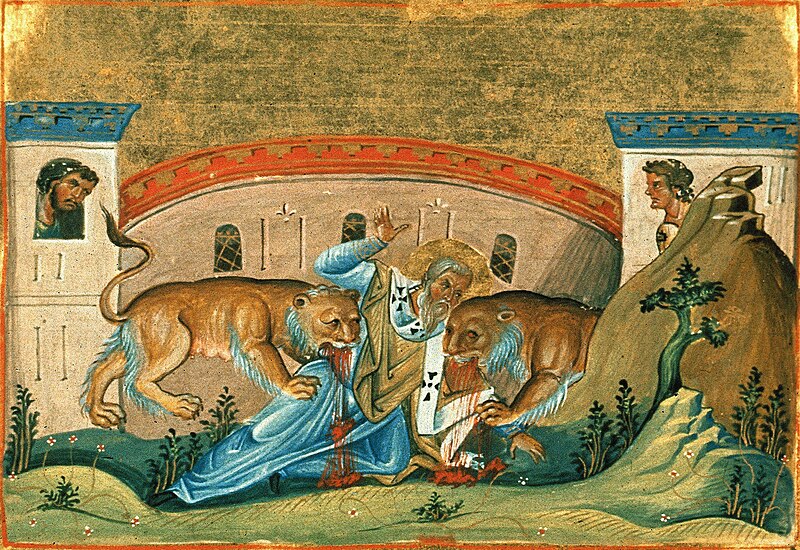
The Christians responded to these accusations and the persecution in two ways: by embracing martyrdom, and by writing apologies. Both of these were powerful witnesses to the pagan culture around them. Christians were being executed for not giving up their faith while simultaneously leaders were writing apologies arguing against the common Roman misconceptions of the faith. These are both expressions of believers’ witnessing for Christ Jesus to those who were around them. Martyrdom was not only accepted by many church leaders, they even went so far as to encourage it. For example, Ignatius states,
Suffer me to become food for the wild beasts, through whose instrumentality it will be granted me to attain to God. I am the wheat of God, and let me be ground by the teeth of the wild beasts, that I may be found the pure bread of Christ. Rather entice the wild beasts, that they may become my tomb, and may leave nothing of my body; so that when I have fallen asleep [in death], … Then shall I truly be a disciple of Christ, when the world shall not see so much as my body. Entreat Christ for me, that by these instruments I may be found a sacrifice [to God]. [12] 

Clearly, Ignatius was holding on to the future promise that he had no reason to fear death, because he knew he would have only “fallen asleep.” Thus, Ignatius embraced death, because he realized there was a future afterwards with God.
Furthermore, the early church saw beyond their lives and realized that God would use them and their deaths to bring more into the faith. Tertullian stated it this way, “The oftener we are mown down by you, the more in number we grow; the blood of Christians is seed.[13] Tertullian continues, “But the Church triumphed through suffering,” and “out of weakness was made strong.”[14] In other words, no matter how much persecution was brought against them Tertullian and the rest of the fathers of faith realized that God was in charge. So if they did die, it was for a greater cause than their individual lives.
Tertullian, also had another reason for strongly supporting martyrdom, which was he believed that Christians needed to earn God’s grace. He believed that Christians should be excited to die for Christ. That once they had embraced the doctrines of Christ, then they would willingly chose to die. To Tertullian, it was the most assured way to have known one would have earned remission for all of his or her sins.[15] Tertullian seemed to have drawn heavily on 2 Timothy 2:11-13 which states,
“It is a trustworthy statement: ‘For if we died with Him, we will also live with Him; If we endure, we will also reign with Him; If we deny Him, He also will deny us; If we are faithless, He remains faithful, for He cannot deny Himself.”[16]

This was clearly a parallel to Tertullian’s thought process. He stated, “Seeing he denies Christ in him by denying that he is a Christian, he has denied Christ Himself also.” [17] This was probably why Tertullian found pleasure and excitement though in persecution because it gave the Christian the opportunity to choose Christ, which in turn would make them partakers in grace since martyrdom secures ones forgiveness.
          Another key to these matters was that they had a very reverential fear of God. They realized that God was more worthy to be embraced than the Roman’s who had temporal power over them. In “The Passion of the Sicilian Martyrs”, two martyrs expressed this idea clearly as they were being interrogated by Saturinus, the proconsul. Cittinus said: “We have none other to fear, save only our Lord God, who is in heaven,” and then Donata said, “Honour to César as Cesar: but fear to God.”[18] In other words, they did not fear what the local politicians could do to them. They would show them honor because God expected that of them. But they would not reject Christ. This was a beautiful expression of their reverential fear for God.
          During those persecutions, there were several apologists who wrote clear arguments responding to the Roman misconceptions of the church. One of those apologist was the philosopher Athenagoras. In his book, “Please for the Christians,” he countered the three misconceptions against the Christians. First, he argued that Christians were not atheist. He started,
[I]s it not absurd to apply the name of atheism? …while we have such incentives to piety—in the established order, the universal harmony, the magnitude, the colour, the form, the arrangement of the world—with reason might our reputation for impiety, as well as the cause of our being thus harassed, be charged on ourselves. But, since our doctrine acknowledges one God, the Maker of this universe, who is Himself uncreated (for that which is does not come to be, but that which is not) but has made all things by the Logos which is from Him, we are treated unreasonably in both respects, in that we are both defamed and persecuted.[19]

In other words, Athenagoras came out and said that they believed in God, the one true preexistent God. Then, he went on further to defend the Christian God as the one and only true God, and why it would have been illogical for believers to reject Jesus Christ.[20]
Next, Athenagoras challenged the second misconception about the church being cannibalistic. He was very clear that the body was not meant for anything other than burial, and that it was not meant to be eaten by any animal period. He stated, “But what need is there to speak of bodies not allotted to be the food of any animal, and destined only for a burial in the earth in honour of nature, since the Maker of the world has not alloted any animal whatsoever as food.”[21] In fact, he started this section off with “but what need is there to speak of bodies” as if he was wondering why he even had to bring it up. At the end of the chapter, he even argued the only reason someone would disagree with this would be if they were “half brutes.”
Finally, he challenged the moral behaviors of the believers when it came to the love feast and the claims that they were rampant with sexual immorality. First, Athenagoras defended the morality of the church and their feast and the holy kiss. He argued that the laws of man were not what they followed, since any evil person could evade them; instead Christians were to follow a higher law of loving everyone as himself.[22]  Moreover, like Tertullian, Athenagoras seemed to think one could lose their salvation. Thus, it was important to make sure one did not break any major laws ordained by God. This is clearly seen when he was writing about the greeting with a holy kiss, “Therefore the kiss, or rather the salutation, should be given with the greatest care, since, if there be mixed with it the least defilement of thought, it excludes us from eternal life.”[23] Hence, these early believers took their faith and their actions very seriously to the point where they were willing to die. Finally, he went on the offensive with a more polemic tone showing the hypocrisy within the Roman Empire.
Conclusion:
          In conclusion, the Christians during the first and second century had shown great courage. The American church could learn several things from this early church. First, that they were not ashamed of Christ or the Gospel; this was because of a reverential fear they had for God and his Son Jesus Christ. Moreover, we see a group of Christians who did not just live in their culture but who also challenged it daily by the way they lived and by the writings they published. Sadly, many Americans today in our religious and safe society do not realize how blessed they are to live here. Moreover, the American church today seems to overemphasize the present state of life by doing all they can to save and preserve their life and legacy. The real focus should be on God and his will for each believer. The early church seemed to have understood that it showed by them living out in their daily lives what Peter stated in his epistle,
Beloved, I urge you as aliens and strangers to abstain from fleshly lusts which wage war against the soul. Keep your behavior excellent among the Gentiles, so that in the thing in which they slander you as evildoers, they may because of your good deeds, as they observe them; glorify God in the day of visitation.(NASB 1Peter 2:11).

Clearly, the American church could learn to forgo the present pleasures of this world and spend more time in God’s Word, grow in maturity, live moral and excellent lives as we are waiting for that day of Christ return. In the end, believers must learn to look beyond the present age, time, and space because life is but a vapor, and live for Christ as the early church did.


[1] Justo L. Gonzalez, The Story of Christianity: The Early Church to the Present Day.( Peabody: Prince Press, 2010 )31-32.


[2] Gonzalez, Story of Christianity, 41.

[3] Henry Chadwick, The Early Church: The Story of emergent Christianity from the Apostolic Age to the Dividing of the Ways between the Greek East and the Latin West.(New York: Penguin,1993) 24.

[4] Everett Ferguson, Backgrounds of Early Christianity,(Grand Rapids:Eerdmans,1993) 185.

[5] Robert L. Wilken, The Christians as the Romans Saw Them,(New Haven: Yale University Press,1984). 18.

[6] Wilken, The Christians, 18-19.

[7] Love feast are meals where all the members of the church would eat together and take the Lords supper (1 Cor 11:20-21; 2Pt 2:13; Jude 12). 

[8] Wilken, The Christians, 17.

[9] Wilken, The Christians, 19.

[10] Gonzalez, The Christian Story, 40.

[11] Gonzalez, The Christian Story, 40.
[12] Ignatius of Antioch, "The Epistle of Ignatius to the Romans", in The Ante-Nicene Fathers, Volume I: The Apostolic Fathers With Justin Martyr and Irenaeus ( ed. Alexander Roberts et al.;Buffalo, NY: Christian Literature Company, 1885), 75.
[13] Tertullian, "The Apology", trans. S. Thelwall, in The Ante-Nicene Fathers, Volume III: Latin Christianity: Its Founder, Tertullian ( ed. Alexander Roberts et al.;Buffalo, NY: Christian Literature Company, 1885), 55.
[14] Tertullian, "The Apology", 60.
[15]For example, Tertullian states, “For who that contemplates it, is not excited to inquire what is at the bottom of it? who, after inquiry, does not embrace our doctrines? and when he has embraced them, desires not to suffer that he may become partaker of the fullness of God’s grace, that he may obtain from God complete forgiveness, by giving in exchange his blood? For that secures the remission of all offences.”  (Tertullian, "The Apology", 1885, 55).

[16] All scripture is from NASB unless stated.

[17] Tertullian, "Scorpiace", trans. Peter Holmes, in The Ante-Nicene Fathers, Volume III: Latin Christianity: Its Founder, Tertullian ( ed. Alexander Roberts et al.;Buffalo, NY: Christian Literature Company, 1885), 642.
[18] "Introduction to the Passion of the Scillitan Martyrs", in The Ante-Nicene Fathers, Volume IX: The Gospel of Peter, the Diatessaron of Tatian, the Apocalypse of Peter, the Visio Pauli, the Apocalypses of the Virgil and Sedrach, the Testament of Abraham, the Acts of Xanthippe and Polyxena, the Narrative of Zosimus, the Apology of Aristides, the Epistles of Clement (Complete Text), Origen’s Commentary on John, Books I-X, and Commentary on Matthew, Books I, II, and X-XIV ( ed. Allan Menzies;New York: Christian Literature Company, 1897), 285.
[19] Athenagoras, "A Plea for the Christians", trans. B. P. Pratten, in The Ante-Nicene Fathers, Volume II: Fathers of the Second Century: Hermas, Tatian, Athenagoras, Theophilus, and Clement of Alexandria (Entire) ( ed. Alexander Roberts et al.;Buffalo, NY: Christian Literature Company, 1885), 131.
[20] Athenagoras makes two strong arguments first he states that they are do not know the truth about God because they have not learned it from God, but their own knowledge.  For example, “they have not been found competent fully to apprehend it, because they thought fit to learn, not from God concerning God, but each one from himself; hence they came each to his own conclusion respecting God, and matter, and forms, and the world.” (Athenagoras, "A Plea for the Christians", 131). In other words, Athenagoras exposed the fact that the romans have created God’s of their own design. 
And then second, he gives a clear argument for why believers should not reject God. His argument is based on the fact the believers have the Holy Spirit and therefore can understand God and believe in him. Therefore, since we know the truth of God and have the Spirit it would be illogical to reject him for the opinion of mere men. For instance, Athenagoras states, “But we have for witnesses of the things we apprehend and believe, prophets, men who have pronounced concerning God and the things of God, guided by the Spirit of God. And you too will admit, excelling all others as you do in intelligence and in piety towards the true God (τὸὂντως θει̂ον), that it would be irrational for us to cease to believe in the Spirit from God, who moved the mouths of the prophets like musical instruments, and to give heed to mere human opinions.” (Athenagoras, "A Plea for the Christians", 131).

[21] Athenagoras, "On the Resurrection of the Dead", trans. B. P. Pratten, in The Ante-Nicene Fathers, Volume II: Fathers of the Second Century: Hermas, Tatian, Athenagoras, Theophilus, and Clement of Alexandria (Entire) ( ed. Alexander Roberts et al.;Buffalo, NY: Christian Literature Company, 1885), 153.
[22] Athenagoras, "A Plea for the Christians", trans. B. P. Pratten, in The Ante-Nicene Fathers, Volume II: Fathers of the Second Century: Hermas, Tatian, Athenagoras, Theophilus, and Clement of Alexandria (Entire) ( ed. Alexander Roberts et al.;Buffalo, NY: Christian Literature Company, 1885), 146.

[23] Athenagoras, "A Plea for the Christians", 146.

Tuesday, November 6, 2012

Anthropology and Harmartiology Doctrinal Statement


Humanity’s origin: I believe that God created humanity by an intentionally purposed act (Gen 1:26-28)to rule over the creation(Gen 1:26b-28;Ps 8:6-8). I believe God made humanity both male and female in the image of God (IOG)(Gen 1:26-28;2:18-25;5:1). Both male and female are intrinsically and equally endowed at creation, and share the IOG corporately and neither one individually is more or less the image. (Gen 1:27;2:18;5:1).  
I believe the IOG is in all people (Gen 1:26-27), and that all humans have intrinsic worth (Gen 9:6; Jam 3:9). The IOG has a structural aspect where we can make rational and moral decisions as rulers on earth (Gen 2:20; Eph 1:11). The IOG has a functional aspect where God has ordained man to rule in His stead physically over creation (Gen 1:26; 2:5; Ps 8:5-6; Rom 20-22). The IOG has a relational aspect where we are to mirror or reflect the image of God as seen in the Trinity by being a unified or a relational community (Gen 1:26; Jon 17:21-22), especially in regards to Christians (Acts 2:43-47;Phil 2:2-4).  Moreover, the IOG has a theological aspect where since the fall, every man’s IOG is marred (Ps 14:1-3; 53:1-3;Rom 3:10-12), but through faith in Christ and His work the image is gradually renewed - first through justification, then gradually through sanctification (Jn 3:3; Rom 6:4; 2Cor 5:16-17; 1 Pet 1:23) until after we die when God will glorify us (Rom 8:29-30). The goal while still here on earth is to strive towards Christ’s likeness (Jn 2:6; Rom 8:29 1Cor 11:1; Gal 3:27; Eph 5:1-2; 1 Pet 2:21) and to have the mind of Christ (Rom 12:2; 1Cor 2:16 Phi 2:5.)
Humanity’s constitution: I believe that each person is divided into material (body) and immaterial (soul/spirit) (Mt 10:28; 1Cor 5:3).  Those who believe in Christ will be separated from their bodies for a short time at death (1 Thess. 4:13-17) until they receive their glorified bodies after Christ’s return (1Cor 15:44).
The origin of the soul: I believe the human soul is transmitted from one’s parents (Gen 1:28; 2:7;5:1-5;46:26; Heb 7:9-10) as God’s secondary agents of creation. Thus, each soul is inherently sinful because it was transmitted by Adam to all his posterity (Ps 51:5; Rom 3:9-3-23;5:12).
Humanity’s sin in the Garden of Eden: I believe sin began in the Garden of Eden with Adam and Eve, when they chose to disobey God and thus, cursed the entire creation (Gen 3).  This sinful nature is also passed down to each person as they inherit the sinful nature or the guilt of Adam (Rom 5:12-21). This means that each person in the human race is innately sinful (Is 53:6; Rom 3:9-23).
The nature and effects of sin on the Humanity: I believe all humanity sinned when Adam and Eve sinned in the garden and thus caused the rest of their posterity to be born with sin in them, marring the entire human race (Rom 5:12-21). Furthermore, due to each person’s sinful nature, it is impossible for anyone to desire God (Jn 6:44) or obtain righteousness through their own ability or power (Is 64:6; Rom 3:29). Salvation is a gift through faith in Christ Jesus, and one can only please God through faith (Heb 11:6). I believe that both the material and the immaterial are corrupted; the material: body (Rom 6:12-13) and the immaterial: mind (Eph 2:3), heart (Jer 17:9; Ecc 8: 11,9:3 Rom 1:21), conscience (1 Tim 4:2), will (2 Tim 2:25-26), and emotions (2 Tim 3:2-4).
          I believe original sin caused corruption of all humanity (Rom 5:12), and spiritual death (Gen 2:17,3:9-10). It caused humanity to feel shame (Gen 3:7). It caused a curse on creation and caused physical death (Gen 3). I believe sin consists of actions and passive acts, for example, wrong thoughts (Mt 5:27-28;1 Jn 3:15), and wrong motives (Mt 6:1-6; Jas 4:3). The Biblical nature of sin consists of shortcomings or falling short (Lev 4:22-24; Rom 2:12), rebellion against God (Is 1:2), lawlessness (1 Jn 3:4), transgression (Dt 17:2), drifting or wandering astray (Lev 4:2-3; Mk 13:5; Heb 2:1) and so on. In general, sin is any falling short of God’s Glory. The result of the generic original sin is that humanity is born inherently sinful and each one will fall short because of it (Rom 3:10, 23). It is because of this sin that those who are not justified through a personal faith in Christ are all children destined for God’s wrath (Eph 2:3), because they are already judged (John 3:18).